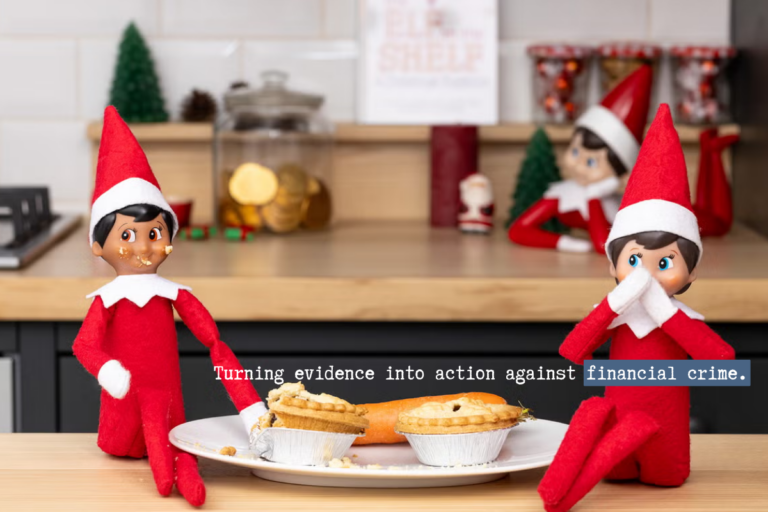
Elf on a shelf
what can banking learn?
Elf on a shelf
what can banking learn?
elf on a shelf: what can banking learn?
Every December, millions of children accept a peculiar premise without much protest: there is a small elf in their house, watching their behaviour, silently reporting back to a higher authority.
The Elf on the Shelf is not loud. It doesn’t intervene.
It doesn’t explain its methods. It just exists – visibly.
And that’s the point.
Long before elves became seasonal compliance officers, the philosopher Jeremy Bentham proposed the idea of the Panopticon: a structure where people behave differently not because they are constantly watched, but because they might be. The uncertainty does the work.
Later, Michel Foucault picked this up and ran with it. His insight wasn’t really about prisons at all. It was about how visibility shapes behaviour. When people know systems are watching, even abstractly, norms shift. Self-regulation kicks in. Power becomes quieter, subtler, and oddly more efficient.
Which brings us, via a festive detour, to financial crime and AML. Most banks today operate their transaction monitoring like a hidden surveillance room. Powerful. Complex. Intentionally opaque. Customers rarely see it, feel it, or understand it – unless something goes wrong and their account is frozen on a Friday afternoon.
From an operational perspective, secrecy makes sense. When criminals understand controls, they route around them. We’ve known this forever.
But here’s the missed opportunity: deterrence doesn’t require disclosure. It requires visibility. The Elf never explains how Santa assesses behaviour. The Panopticon doesn’t show the guard. The power lies in signalling presence, not revealing process. In financial services, we’ve largely skipped this layer.
Customers are told, in abstract terms, that banks “monitor transactions for fraud and money laundering.” Usually buried in a terms-and-conditions document no one reads. Then we’re surprised when people feel confused, infantilised, or unfairly treated when controls trigger.
What if, instead, we designed for felt guardianship? Not fear. Not threats. Not crime-control theatre. But quiet, confidence-building signals woven into the user experience: small moments that say, “We’re watching over your money – so you don’t have to.” This could be as simple as contextual nudges that make monitoring visible without being specific. A reassurance after a late-night payment. A message that frames checks as protection rather than suspicion. A design choice that communicates care, not control.
Done well, this kind of visibility does three things at once.
- First, it deters casual misuse and opportunistic harm by reminding people that financial systems are not blind. Most financial crime is not committed by master criminals – it’s committed in moments of pressure, panic, or rationalisation. Visibility interrupts that moment.
- Second, it builds trust. People tolerate friction far better when they understand its purpose. An unseen system feels arbitrary. A visible one feels intentional.
- Third, it subtly reshapes norms. Just as children internalise the presence of the Elf, customers internalise cues about what “normal” financial behaviour looks like – without being lectured or policed.
None of this means exposing rules, thresholds, or investigative logic. That would be reckless. This is about UX as behavioural design – using signals, language, and timing to communicate oversight without revealing the machinery behind it.
Foucault warned that invisible power can become alienating and dehumanising. Bentham, more optimistically, believed visibility could create order with minimal force. Between the two sits a useful lesson for modern banking. Sometimes, the most effective control isn’t the one hidden deepest in the system. It’s the one quietly sitting on the shelf, reminding everyone that someone is paying attention.
And no, it doesn’t have to be dressed as an elf.
3rd Floor, 86-90 Paul Street, London, England, United Kingdom, EC2A 4N
© 2025. The Financial Crime Lab. All Rights Reserved