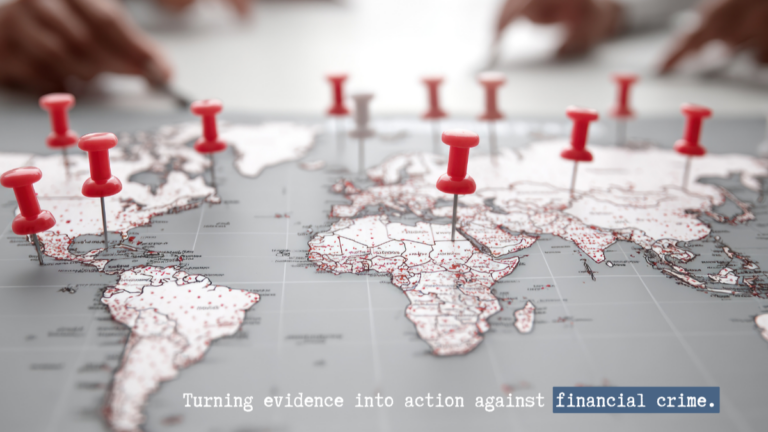
Every year, we get a little clearer picture of what global fraud actually looks like. The patterns shift, the methods mutate, and the boundaries between “cyber”, “financial”, and “social” crime blur a little more. As a criminologist, I read these global fraud reports not just for the numbers but for what they say about the systems that make crime possible. Behind every data point is a design flaw, in policy, technology, or human decision-making, that someone has exploited.
What the 2025 data reveals about the direction of fraud
This year’s Global Fraud Index 2025 (thank you Sumsub) offers one of the most structured attempts yet to make sense of that shifting terrain. It’s not just a headcount of frauds; it breaks risk into layers – fraud activity, resource accessibility, government intervention, and economic health.
That framing matters. It moves the conversation away from “how many frauds were there?” towards “why are some systems more resilient than others?”
Global average fraud index: 2.79 – composed of fraud activity (2.07), resource accessibility (1.38), and government intervention (0.65). This suggests that while many countries are improving their fraud defences, institutional response capacity and regulatory coordination still lag behind activity levels.
We see, for example, that jurisdictions with strong intervention and resourcing aren’t necessarily those with the lowest fraud activity. That tells us something subtle but important: fraud isn’t only about regulation or tech controls, it’s about alignment across systems. You can have all the safeguards in the world, but if economic conditions or accessibility gaps create pressure points, risk will seep through them.
Singapore, once top of the global fraud resilience ranking, has fallen to 10th place, showing how dynamic, not static, these risks are. Luxembourg, Denmark, and Finland now sit among the world’s 15 most protected countries.
Fraud is no longer a crime of the margins
A decade ago, fraud was still treated as an unfortunate by-product of digital life. Now it’s the dominant global crime threat, and its victims range from consumers to entire governments. The more we digitise, the more “fraud risk” simply becomes “systemic risk”.
Sumsub’s data indicates a 23 % year-on-year rise in global fraud activity, with spikes linked to generative-AI-enabled identity fraud and synthetic document creation.
The 2025 Index quietly confirms what many of us have observed in practice: criminals aren’t innovating faster than legitimate actors, they’re simply less constrained. They test, adapt, and collaborate across borders more fluidly than regulators or service providers can. That’s why cross-sector intelligence like this matters. It gives us a common map, even if the terrain is still shifting underfoot.

The value of shared intelligence
As someone who builds policy, campaigns, and interventions from evidence, I find value in the Index not because it’s definitive, no dataset ever is, but because it connects dots that often sit in silos.
When we can compare levels of fraud activity with the accessibility of counter-resources, we can start to see where intervention has the greatest leverage. When we can track year-on-year shifts, we begin to read the story of adaptation – who is learning fastest: us or them?
In several high-income regions, resource accessibility scored under 1.5, meaning the systems for prevention and response are less equipped than the threat environment demands.
A note of caution and optimism
Of course, aggregated intelligence always has its limits. It can’t capture the nuance of social engineering, or the lived experience of individuals drawn into mule networks or investment scams. But it helps us see the scaffolding that supports those crimes – the weak joins, the underfunded oversight, the mismatched incentives.
And in that sense, reports like this are less about measurement and more about mobilisation. They give researchers, policymakers, and practitioners a shared baseline from which to ask better questions.
Turning insight into action
The Global Fraud Index 2025is a useful reference point, but it’s what we do with it that counts. Use it to challenge assumptions, to test your own organisational resilience, or to inform smarter public policy. The full report is coming out on the 26th November, so make sure you take a look for yourself.
The real insight isn’t that some countries are “safer” than others; it’s that fraud risk is increasingly entangled with how we build and govern our digital societies. The smarter we get at reading that relationship, the closer we come to prevention that actually keeps pace with innovation.
Fraud prevention isn’t just about stopping crime, it’s about building systems where exploitation is harder, slower, and less rewarding. The foundations of this need to be built on evidence that acts as a critical mirror to global action or in-action on financial crime.